
By RF Modulator 3298
Technical Strengths and Limitations
Definition: An RF modulator is a special device that changes low-frequency signals, like audio and video, into high-frequency radio frequency signals (RF signals). Its main job is to use spectrum shifting techniques (such as AM, FM, or QAM) to make baseband signals suitable for wireless channels.
Technical Value: In broadcasting systems, this device allows multiple signals to be sent together (multiplexed), such as in satellite TV using 64-QAM (Quadrature Amplitude Modulation). This helps save spectrum resources. Compared to old analog modulators, modern digital solutions use bandwidth more efficiently (up to 50% better).
A modulator and a demodulator work together in a signal system. The modulator at the transmitter side changes baseband signals into RF signals. The demodulator at the receiver side uses coherent demodulation to recover the original information.
System Integration Example:
Cable TV network: Front-end modulator cluster → Fiber backbone → End-user set-top box
Advantage Comparison: Brand X series modulators use adaptive pre-distortion. This reduces demodulation error rate by 35% compared to standard models.
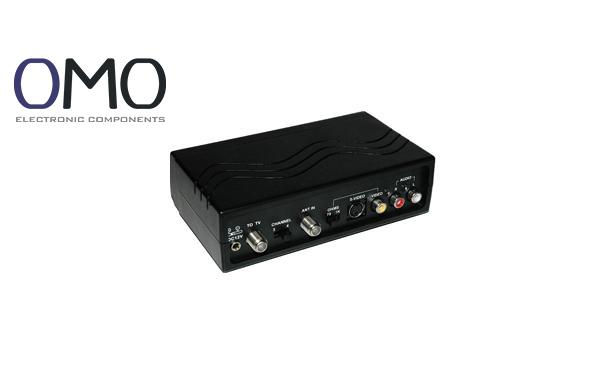
The table below shows the main steps and technical details:
| Stage | Core Component | Key Technology | Typical Value |
| Carrier Generation | Crystal Oscillator | PLL (Phase-Locked Loop) Synthesis | Phase noise < -110dBc/Hz |
| Signal Modulation | Double-Balanced Mixer | I/Q Quadrature Modulation | Sideband suppression > 40dB |
| Filtering and Amplifying | SAW Filter | Doherty Power Amplifier | Output Power 30dBm ± 0.5dB |
Data Visualization: After using an advanced pre-correction algorithm, the Modulation Error Ratio (MER) improves from 28dB to 34dB.
In a satellite uplink station, the modulator changes the digital TV signal to a higher frequency (from L-band to Ku-band). A ground broadcast case shows:
Advantage Comparison: With a new GaN (Gallium Nitride) power amplifier module, power use is 22% lower than traditional solutions.
In drone video transmission, COFDM (Coded Orthogonal Frequency Division Multiplexing) modulation is used:
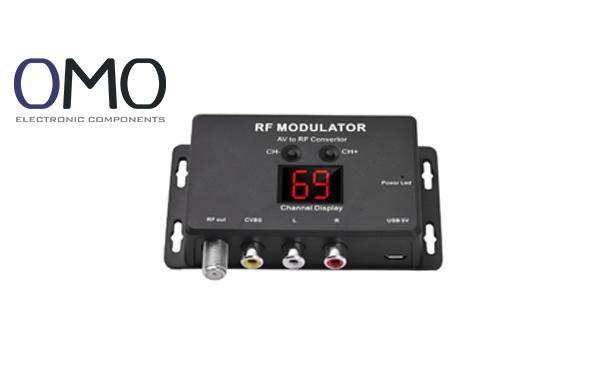
Common interface setup:
HDMI source → Encoder (H.264/H.265) → RF Modulator →
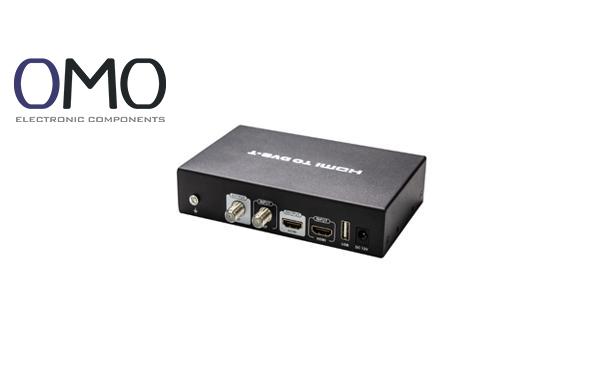
Multi-Scenario Compatibility:
| Scenario | Traditional Limits | This Product Solution |
| Dense Urban Areas | Adjacent channel interference > 12dB | Digital comb filtering suppresses 23dB |
| Long-Distance Transmission | 0.15dB/km loss (2.4GHz) | High-power amp compensates 0.12dB/km |
Electromagnetic Compatibility: Passes FCC Part 15 Class B. Emission levels are 6dB lower than the limit.
Three-level stability solution:
Advantage Comparison: Compared to normal TCXO (Temperature Compensated Crystal Oscillator), long-term frequency stability improves by 10 times.
An RF modulator is an electronic tool designed to transform audiovisual (AV) signals into radio frequency (RF) waveforms. This translation process enables both modern and legacy equipment to remain functionally compatible and operational within the same system.
The fundamental operation of an RF modulator involves transforming lower-frequency baseband signals into higher-frequency radio frequency signals by employing modulation techniques, frequency mixing stages, and signal filtering components.
RF modulators serve as an interface between legacy television systems and modern audiovisual devices, transforming component audio-visual outputs into broadcast-frequency signals compatible with older TV receivers.
A modulator's primary role is to transform a baseband signal into a modified format suitable for effective propagation through communication channels. This conversion process simultaneously enables advantageous functions including frequency adaptation, signal quality improvement, and efficient allocation of spectral resources.